
A plastering job can look simple until the finish shows every mark, the new render cracks, or the wall is painted before it has dried properly. Choosing a plasterer in Swindon is therefore less about finding the cheapest name and more about matching the person or team to the work: a small patch repair, a full-room skim, external rendering, lime plaster, drylining or a larger commercial project.
Swindon is a town built around routes of connection — rail, industry and the speed of growth. That practical reality shows up in its buildings. Railway Village and older central properties can present different repair and moisture questions from newer homes in West Swindon, North Swindon or the New Eastern Villages. A commercial unit near the M4 or a business park may need a different programme, access plan and finish from a bedroom ceiling in Old Town. The plasterer should assess the building in front of them, not sell one method for every wall.
Choosing a plasterer in Swindon starts with the surface
Before comparing businesses, define the problem. “I need plastering” may mean several different things:
- skimming a sound wall or ceiling to create a smooth finish;
- repairing cracks, holes or water-damaged areas;
- re-plastering a room or an entire property;
- installing plasterboard through drylining or dot and dab;
- rendering an external wall;
- applying lime plaster to a period or traditionally built property;
- adding coving, cornice or other decorative plasterwork; or
- laying floor screed as part of a wider renovation.
These jobs overlap, but they are not interchangeable. A plasterer experienced in smooth internal skimming may not be the right choice for a breathable lime finish. A commercial drylining contractor may be well suited to a new office or school project but not necessarily interested in a small domestic repair. A renderer may be the correct specialist for an external façade while another contractor is better for a damaged ceiling.
The first useful question is not “Who is the best plasterer in Swindon?” It is “What system and finish does this building need, and who can explain the preparation, materials and drying process clearly?”
Quick decision summary
For general domestic plastering and repairs
Duke’s Plastering Services, Paddy O’Dwyer Plastering, All Aspects Plastering & Decorating and K.O Plastering describe broad domestic plastering services. Their stated work includes combinations of plastering, repairs, skimming, rendering and related finishes.
For a small repair, ask whether the contractor is willing to take on the job and how the repair will be blended into the surrounding wall. A patch that is structurally sound but badly feathered can remain visible after decorating.
For external rendering
Paddy O’Dwyer Plastering describes silicone coloured renders, K Rend and other render systems. K.O Plastering lists spray, monocouche, silicone and traditional rendering, while Duke’s describes rendering alongside plastering and drylining. All Aspects also lists rendering and pebble dashing.
The right choice depends on the wall, exposure, existing finish, movement, damp details and desired appearance. Do not choose a render solely by colour or a claimed lifespan without a proper assessment of the substrate.
For lime plaster and older properties
Limeway Wiltshire focuses specifically on lime plastering for Swindon and Wiltshire. Paddy O’Dwyer Plastering also describes lime plastering as part of its service range, and directory listings identify traditional lime work among the services available in the Swindon market.
Lime is not simply a more expensive version of modern gypsum plaster. Its breathability, flexibility and compatibility with older walls may matter. A contractor should explain whether lime is appropriate and how the existing wall build-up will be handled.
For drylining and larger projects
K.O Plastering describes drylining, dot and dab, stud work and commercial projects. AB Drylining presents commercial and industrial plastering, rendering and drylining across the South West, including Swindon. These providers may be relevant to new-build, office, school, refurbishment or multi-phase work where programme coordination matters.
For a combined plastering and decorating job
All Aspects Plastering & Decorating combines plastering with painting, decorating, wallpaper hanging, pebble dashing and patch repairs. This may reduce handovers between trades, but you should still ask when the plaster will be ready for decoration and what preparation is included before painting.
Plasterers in Swindon to consider

The businesses below form an editorial shortlist, not a ranking. Their service descriptions differ, and information that is not stated should be confirmed before appointment.
Duke’s Plastering Services
Duke’s Plastering Services presents a plastering service for Swindon, Bristol and surrounding areas. It describes plastering, rendering and drylining, and says it works on projects ranging from patch and repair work to whole-house renovations.
That broad scope may suit a homeowner who is still defining the project. A small repair, a full re-skim and an external render job require different preparation and sequencing, so the useful test is whether the contractor separates those options in the quotation.
Duke’s describes a customer-focused and hassle-free approach, but those are provider descriptions rather than an independent assessment. Ask for the proposed material, number of coats, preparation method, drying period and making-good responsibilities.
The stated Swindon and Bristol coverage also means that the exact job location should be confirmed. A broad area statement does not prove that every address in the borough is included at the same price or on the same timetable.
Potential fit: domestic plastering, repairs, rendering and drylining where the customer wants one contractor to discuss a project from small work through to renovation.
Confirm before booking: exact Swindon coverage, availability, surface preparation, materials, drying time, protection of floors and furniture, and the written scope of any repair or renovation.
Paddy O’Dwyer Plastering
Paddy O’Dwyer Plastering describes plastering, plaster repairs, rendering, silicone coloured renders, K Rend, external insulation and lime plastering. The business presents solutions for homes and businesses and describes projects ranging from smaller upgrades to full-house plastering and property rendering.
The range of finishes is useful when the customer is comparing internal and external work. The site describes smooth internal finishes, lime plaster, polished render, monocouche render and traditional textured render. Those systems have different application methods and should not be treated as interchangeable decorative choices.
Lime plaster is particularly relevant where the wall needs a breathable finish or where the existing construction is traditional. The contractor should inspect the wall before recommending it. Damp, salts, cement repairs, trapped moisture and movement can all affect the right specification.
The provider also displays customer feedback and project descriptions. These can help a customer understand the type of work undertaken, but they do not replace a written specification, references relevant to your property or evidence of appropriate insurance.
Potential fit: customers comparing internal plastering, repair work, lime plaster and modern external render systems.
Confirm before booking: the exact system proposed, substrate preparation, external insulation details if relevant, drying and weather requirements, price for each stage and whether the contractor covers your Swindon address.
Limeway Wiltshire
Limeway Wiltshire presents lime plastering throughout Swindon and Wiltshire for residential and commercial customers. Its service description explains lime plaster as a traditional material made from lime, sand and water, with a finish that can allow moisture to escape and accommodate slight movement.
That makes Limeway particularly relevant to period homes, traditionally built properties and projects where the wall build-up needs to remain compatible with breathable construction. It may also be relevant to customers who want a natural or traditional finish, but aesthetic preference alone does not establish that lime is necessary.
The business states that it can visit a property for a site survey and prepare a quotation. A site assessment is important for lime work because the existing plaster, masonry, paint layers, damp history and previous repairs can affect the specification.
The provider describes a wider Wiltshire coverage that includes towns such as Marlborough, Chippenham, Devizes, Malmesbury and Cirencester. Those are separate places from Swindon. Confirm the exact project location and whether the quotation includes travel, preparation, materials and finishing.
Potential fit: period properties, traditional walls and projects where breathability and material compatibility are central to the decision.
Confirm before booking: whether lime is appropriate for the wall, the lime system and finish, preparation and removal of existing materials, drying time, decoration requirements and the exact Swindon service boundary.
All Aspects Plastering & Decorating
All Aspects Plastering & Decorating presents itself as a Swindon-based family-run business offering plastering, rendering, pebble dashing, skimming over Artex, painting, decorating, wallpaper hanging and patch repairs.
This combination may suit a homeowner planning a room refresh rather than plastering alone. The benefit is a possible reduction in handovers between the plastering and decorating stages. The risk is that customers may compare an all-in-one quote with a plaster-only quote without checking the same scope.
Ask whether the quote includes preparation, removal of loose or failed material, plasterboard, skimming, sanding, primer and final decoration. Plaster needs appropriate drying time before paint is applied, and the programme should allow for that rather than treating the finished surface as immediately ready.
The business states that it serves Swindon and a number of surrounding Wiltshire locations. The precise address and service boundary still need confirmation for a specific job in Swindon Borough.
Potential fit: domestic rooms and refurbishment projects that combine plaster repairs, skimming, rendering and decorating.
Confirm before booking: whether the work is plaster-only or includes decorating, the number of coats, preparation of Artex or damaged surfaces, drying time, materials, protection and the final handover standard.
AB Drylining
AB Drylining presents commercial and industrial plastering, rendering and drylining work across the South West, including Swindon. Its stated projects include new school halls, office blocks and other commercial settings.
The business describes CSCS certification and PASMA and IPAF accreditation for its team. These are provider claims that should be checked against current documentation when they matter to a site’s procurement or health-and-safety requirements.
AB Drylining explains the difference between wet plastering and drylining and describes monocouche rendering. It also discusses lime and clay plasters as traditional or natural options. That range may be useful for a commercial client comparing wet finishes, dry systems and external render.
The commercial focus matters. A school, office or industrial site may need method statements, site induction, access planning, protection of occupied areas, phased delivery and coordination with other trades. A domestic customer should confirm whether the project size is suitable for the contractor’s current programme.
Potential fit: commercial, industrial, education, office and larger refurbishment work where drylining, wet plastering or rendering must be coordinated with a wider build programme.
Confirm before booking: current accreditation documents, project capacity, site requirements, programme, access equipment, materials, waste handling and whether the company will work on an occupied site.
K.O Plastering Ltd
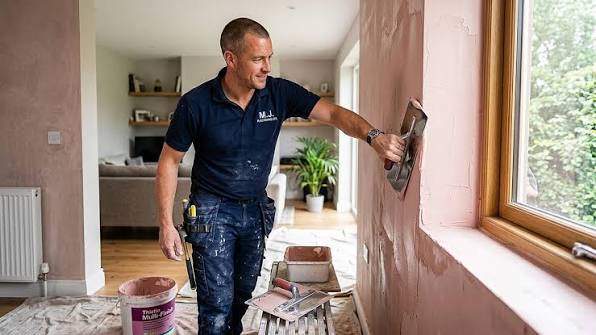
K.O Plastering describes itself as a Swindon-based plastering and rendering specialist covering domestic and commercial work. Its listed services include spray rendering, monocouche render, silicone render, traditional rendering, pebble dashing, two-coat plastering, float and set, coving, drylining, dot and dab and floor screeding.
The breadth of the service list makes the provider relevant to both internal and external projects. Its descriptions also distinguish systems that customers often confuse. Dot and dab is a plasterboard fixing method, while float and set is a traditional plastering approach. Neither should be selected without considering the wall, acoustic needs, moisture, fire requirements and the intended finish.
K.O Plastering describes commercial projects, new construction, repairs, restorations and work on occupied or operational sites. For a business or landlord, that raises practical questions about phasing, protection, noise, access, tenant communication and cleaning.
The company also states that it works beyond Swindon in Wiltshire, the Cotswolds, Berkshire, Gloucestershire and Oxfordshire. Those wider areas should remain labelled as separate regional coverage rather than being treated as Swindon neighbourhoods.
Potential fit: domestic and commercial plastering, internal drylining, external rendering and projects where several plaster or render systems need to be compared.
Confirm before booking: the proposed system, internal or external scope, insulation or board specification, programme, weather constraints for render, site protection and the exact address coverage.
Plastering services explained
Skimming
Skimming is a thin finishing coat used to create a smooth surface on a wall or ceiling. It may be applied over suitable existing plasterboard or plaster, but the background must be sound, clean and properly prepared.
Skimming is not a cure for movement, damp or failed backing plaster. If the surface is loose, contaminated, badly cracked or uneven, the contractor may need to remove material, repair the background or install new board first. Ask what preparation is included rather than accepting “skim the room” as a complete specification.
Patch repairs
A patch repair can address a defined hole, crack, impact mark, leak-damaged area or local failure. The visible finish depends on how the new material is tied into the existing surface and how the surrounding area is prepared for decoration.
Find out whether the cause of the damage has been resolved. Plastering over an active leak, persistent condensation or structural movement can produce a short-lived result. A careful plasterer should identify when another trade or an underlying repair is needed before finishing the wall.
Drylining and dot and dab
Drylining uses plasterboard and associated systems to form an internal wall or ceiling finish. Dot and dab fixes boards to a masonry background with adhesive dabs. Stud systems can create a framed wall or partition and may allow insulation or services to be incorporated.
The correct system depends on moisture, fire, acoustic, thermal, fixing and space requirements. A plasterboard finish can be faster than a wet-plaster system in some situations, but that does not mean it is suitable for every wall. Ask what board type is proposed and how sockets, radiators, skirting, doors and heavy fixtures will be handled.
Rendering
Rendering is applied to external walls to provide a protective and decorative finish. Swindon plasterers advertise traditional, silicone, monocouche, spray and other render systems.
The existing wall and exposure should guide the choice. The contractor should inspect cracks, movement, previous coatings, damp, masonry, mesh requirements, edges, openings and the condition of the substrate. Weather also matters during application and curing. Render should not be treated as a cosmetic layer that can hide every defect indefinitely.
Lime plaster
Lime plaster is breathable and can be more compatible with traditional masonry than some modern cement-rich systems. It is often considered for older or historically built properties where moisture needs to move through the wall and where flexibility matters.
Lime is not automatically the right answer for every old-looking house. The age, construction, previous repairs, paint, damp source and intended finish should be assessed. A contractor should explain which lime material and finish is proposed and how long the work will need to dry before decoration.
Coving and decorative plaster
Coving, cornice and Artex-related work require a careful match between the existing ceiling, wall and new finish. The customer should ask whether the contractor will repair, remove, cover or replace the existing decorative detail.
Decorative work is often judged at close range. Include joints, corners, mitres, preparation, painting and making good in the written scope. A low headline price can be misleading if it excludes the finishing work needed to make the result look complete.
How to choose the right plasterer for your Swindon property
Match the contractor to the building
A newer home in North Swindon or the New Eastern Villages may need a different approach from a traditional property in Old Town or Railway Village. That does not mean one area is automatically better or more difficult. It means the wall construction, previous alterations, access and intended use should be checked.
For older properties, ask about breathable materials, salts, damp and the risk of trapping moisture. For newer properties, ask about board systems, movement joints, insulation and the finish required for new decoration. The right contractor should explain the reason for the method.
Match the contractor to the project size
A sole trader may be well suited to a bedroom, hallway or local repair. A specialist team may be more appropriate for a full house, external render or phased commercial refurbishment. Neither model should be judged by size alone.
Ask who will be on site, whether subcontractors will be used, how many projects are being run at once and who is responsible for quality control. For a larger project, request a programme with preparation, application, drying, inspection and decoration stages.
Check the written quote
A plastering quote should describe the area, surface condition, preparation, materials, coats, finish, access, protection, waste and making good. It should state whether VAT applies and identify payment stages where relevant.
Do not accept “plaster whole room” as the complete scope. Ask whether it includes ceilings, reveals, window boards, corners, sockets, skirting removal, boarding, insulation, coving, sanding and final cleaning.
For external rendering, include scaffolding, mesh, beads, reveals, downpipes, vents, windows, colour, texture, weather limitations and the treatment of cracks. For lime work, include removal of incompatible materials and the drying and decoration plan.
Ask about insurance and competence
Public liability insurance is relevant to work in an occupied home or commercial building. For larger sites, the client may also need method statements, risk assessments, site training or evidence of trade and access competence.
Do not rely only on a badge, logo or general statement. Ask for current documents where the project requires them and check that the insured business is the one named on the quotation.
How much does plastering cost in Swindon?
There is no dependable single price for a plasterer in Swindon. Cost changes with room size, surface condition, access, preparation, materials, finish, drying requirements and whether the work is internal or external.
Indicative local trade guides place ordinary plastering jobs across a wide range rather than one fixed figure. A small wall or patch may be relatively modest, while a full-room skim, extensive rendering or lime-plaster project can rise substantially once preparation and access are included. Treat online averages as orientation only, not as a quote for your property.
The most useful cost questions are:
- Is the price for labour and materials?
- Is preparation included?
- Does the quote cover ceilings and reveals?
- Are boards, insulation, mesh, beads or scaffolding included?
- Is waste removal included?
- Does the price include decoration or only plastering?
- Will additional damage be reported before work continues?
- What payment stages are required?
Get at least two written quotes for non-urgent work, but compare the scopes rather than choosing the lowest number. A cheaper quote that omits preparation or making good may become the more expensive option once the job is underway.
Drying, decorating and protecting the result
Wet plaster needs time to dry. The period depends on thickness, ventilation, temperature, humidity, the substrate and the material. A contractor should give practical guidance for the particular room rather than promise a universal date.
Do not seal a damp plaster surface with ordinary paint before it is ready. Ask whether a mist coat or another primer is required, when decoration can begin and how the room should be ventilated. Excessive heat can also create problems if it dries the surface unevenly.
Protect the new finish from impact during the rest of the renovation. Other trades should know when the walls are ready for skirting, sockets, cabinets, flooring or decoration. A clear sequence prevents a finished surface being damaged by the next phase.
For external render, weather is part of the programme. Rain, frost, strong sun and unsuitable temperatures can affect application and curing. Do not pressure a contractor to apply render in conditions they consider unsuitable simply to meet an arbitrary date.
What to do if plaster is cracked, damp or falling away
A crack is a symptom, not a specification. Small hairline cracks may result from drying or minor movement, while wider or recurring cracks may need further assessment. The plasterer should explain what they can repair and when another professional is needed.
Damp plaster may be caused by a leak, failed guttering, condensation, penetrating moisture, rising damp, plumbing or a defect in the building envelope. Applying a fresh finish without addressing the moisture source usually gives a temporary result.
If a ceiling is bulging, loose or water-damaged, keep people away from the area and address the leak or structural concern before arranging cosmetic plastering. A plasterer can repair the surface, but should not be expected to diagnose every building defect without the right information.
FAQs
How do I find a reliable plasterer in Swindon?
Start with the exact work rather than a general search for the cheapest plasterer. Ask for relevant examples, a written scope, current insurance where needed and an explanation of preparation, materials and drying. Compare two or more quotes for non-urgent work.
What is the difference between plastering and rendering?
Plastering generally refers to internal wall and ceiling finishes, while rendering is usually an external wall finish. The materials, exposure, preparation and weather requirements differ. Some Swindon contractors offer both, but the quote should identify the exact system.
Is lime plaster suitable for an older Swindon property?
It may be, particularly where the building uses traditional breathable materials, but age alone is not enough to decide. The existing wall, paint, damp history, previous repairs and intended finish should be assessed by someone experienced with lime systems.
How long does plaster take to dry before painting?
There is no universal timeframe. Thickness, ventilation, temperature, humidity and material affect drying. Ask the contractor for property-specific guidance and the correct preparation before decorating.
Should I use one company for plastering and decorating?
It can simplify handover, and All Aspects Plastering & Decorating describes both services. However, a combined quote must still separate plastering, drying, preparation, primer and final decoration so you know what you are buying.
Can a plasterer repair water-damaged plaster?
Often, yes, but the moisture source must be dealt with first. Ask whether the contractor is repairing the surface only or also addressing the leak, gutter, plumbing, condensation or external defect that caused the damage.
Is drylining better than wet plastering?
Neither is automatically better. Drylining can suit certain new-build, partition or insulation requirements, while wet plaster may suit masonry, difficult areas or a particular finish. The choice should follow the wall, performance requirements, programme and decoration plan.
Do I need a plasterer for a small patch repair?
Some contractors accept small jobs and others focus on larger projects. Ask before requesting a visit. A good small repair quote should explain how the patch will be blended, what caused the damage and whether decoration is included.
Final checklist before appointing a plasterer
Before you choose a plasterer in Swindon, make sure you have:
- a clear description of the surface and the problem;
- the proposed plaster, render, lime or drylining system;
- preparation and removal work identified;
- ceilings, reveals, corners and edges included where relevant;
- materials, boards, insulation, mesh and beads listed;
- drying and decoration requirements explained;
- access, protection and waste arrangements confirmed;
- insurance and competence documents checked where appropriate;
- payment stages and variation approval in writing; and
- a clear process if hidden damage appears after work starts.
Swindon’s routes connect homes, business parks, older railway communities and fast-growing areas, but the right plastering decision still begins with the wall in front of you. Choose the contractor who can identify the surface, explain the method, price the preparation honestly and leave a finish that is ready for the next stage. Speed matters only after the material, workmanship and sequence are right.

Swindon grew around railways, engineering and its position as an important connection between places, and that sense of movement still feels relevant today. The modern town is a mixture of established neighbourhoods, newer developments, independent businesses, retail, food, leisure and a growing range of things to do. Our coverage focuses on that everyday Swindon: local services, businesses, restaurants, events, attractions and places worth discovering. We’re particularly interested in how the town continues to change and what that means for people living here. Practical information matters, but so does showing the character beneath Swindon’s reputation as a transport and commuter town.